Rss Feed Tweeter button Facebook button

this is NOT ok

You are currently browsing the archive for the this is NOT ok category.

thisisnotok

I used to love snow days.

Listening to the radio DJ rattle off the list of school districts.  Waiting on pins and needles to hear my district called, followed by the magic words: “Closed”

Spending the rest of the day whining to my mom, “What can I do now, Mom?  I’m bored.  What can I do?”

I ask the same question now, but for different reasons.

I look at the 153 million orphans in the world, and I have a hard time figuring out where to start.  I look at that number and think, “it’s overwhelming, scary, and expensive!”  I freeze and whine, “What can I do?”

Overwhelmed

I searched “Adoption.” Google gave me 34 million responses in under a second.  ”Orphans” returned 4.4 million.  I love technology, but it’s also made the world really overwhelming.

I had to narrow it down a little bit first.  OK, a lot.

I spent a couple hours surfing around the Web, just reading blogs and comments, clicking on things that looked interesting.  After a little bit, i started to see a pattern in what types of things I clicked through to.  Then I focused.

I had to look at how I’m wired up, focus in that direction, and then take a little baby step.

You can too.

Scared

I’m scared of crowds.  And new people.  And anyplace outside my house.  Not to the point of agoraphobia, but I’d be pretty comfortable if I never had to wear anything but pajamas.

I get anxious about a lot of things.  And downright scared at others.  But fear is a bully.  And like most bullies, fear can be beaten.  The way I beat it is to start small and build on the momentum.

Broke

The economy still sucks.

If you’re behind on rent, or struggling to put food on the table, then now might not be the time to make big donations or commit to a 3-week mission trip to India.  But maybe you have time to hang out with foster kids at a place like Big House?

Or maybe you’re making ends meet, but there are things in your life that you could cut back on a little bit?

For me, it was eating out.  We ate out a lot.  And by a lot I mean four meals a day.  We will forever be the HunanChickenWithBroccoliPeople to the staff of Golden China.

They miss us now.  But there’s a kid at Dulce Refugio that has uniforms and school supplies because we don’t each so much carryout anymore.

What does this all mean?

It means you don’t have to solve the entire problem, today, alone.  We’re all in this together.  If I take a little step toward something pulling on my heart, and you step toward what pulls on your heart…I think you see where this is going.

Do you love babies?  Volunteer at a local crisis pregnancy center, sew bibs or make blankets for special needs infants in the foster system, or donate to a ministry that rescues baby girls from infanticide,

Do you speak a different language?  Volunteer to help immigrant single moms learn English, sponsor a kid from a country that speaks the same language and write monthly letters in their native tongue, go on a short-term mission trip.

Are you with me?

Do you have a unique life experience or talent?  Use that.  Do you have baggage from your past that helps you relate to kids in difficult places?  Use it to help them heal.

Let’s get creative.  Find one thing that you can do in less than two hours or for less than $20 that can help one kid in your town, and commit to do it this month.

Take a step with me today.

What is your two-hour-twenty-buck thing?  Leave a comment….

thisisnotok

Solving the problem of 153 million orphans seems overwhelming; it seems impossible.  But with many people taking steps toward the goal together, we CAN make a difference.

On Monday, we’ll talk about how.


Thanks to Michael Hyatt for sharing this on his blog.  Truly inspiring.
What inspires you?  Leave a comment…
This is important.  Subscribe via email or RSS so you don’t miss a post, and use the buttons right here to tell your friends and followers about this.  Awareness –> Action –> Impact
thisisnotok

I’ve never really been the social activist type.

Sure, when I was 14, I sent my allowance to Greenpeace.  How could I not?  They sent me a postcard with a cute little baby seal on it and then told me about how mean-spirited Republicans beat them with clubs.  But then I grew up.  And became a Republican.

(Yeah, there, I said it.  I’m out.  Don’t judge me.)

For the record, I am not mean-spirited, and I don’t kill baby seals.

But just like I couldn’t ignore the baby seals when I was 14, I can’t ignore the fact today that there are 153 million orphans in the world.

What’s your worldview?

A majority of Americans identify themselves as Christian.  Another large segment of the US population identify themselves as Jewish.  Between those two traditions, 176 million people in the US are represented.

For those of us who adhere to those faiths, both the Old Testament and the New Testament call followers to care for the widows and orphans.  Repeatedly.

I’m reminded to care for others more often than I’m told to not murder people.

God is telling me that I have a responsibility to society.  

  • He knows the that pain that is caused when we focus on our own comfort and we forget about others.
  • He knows the cost to the community when certain members are devalued or forgotten.
  • He knows the damage to our hearts when we ignore suffering and injustice.
  • He knows the joy we will gain when we serve others.

“But I’m not a Christian….”

Caring for others is not a uniquely Christian call.  In fact, most major religions and philosophies include helping those who are less fortunate as “the right thing to do.”  Most atheist and agnostics agree that social responsibility is an important value.

Throughout history, there have been individuals and societies that rejected this and devalued the poor, the widowed, the orphaned; those are the leaders and cultures that history cries out against.

Can anyone honestly argue that any child deserves to starve to death?

Can anyone honestly argue that any child deserves to be sold into slavery?

Can anyone honestly argue that any child deserves to be raped over and over again for money?

Regardless of your religion or philosophy, this is NOT ok.

So shouldn’t the Government solve this?

It’s a big problem that demands a big solution, right?

Yes and no.

Sure, governments have a role in both the problem and the solution.  I just don’t think it’s the job of the government to solve every problem. In fact, when we depend on the government to carry the responsibility, it denies us the opportunity to engage and serve.

This is so much bigger than any individual government.  And while global cooperation is critical, we all know that big systems move slowly.

Children die while rulers talk about what to do.

The complexity of the problem demands a variety of actions and solutions.

The urgency of the problem demands we take action now.

OK, OK, I care….

Some of you are already deeply engaged in meeting the needs of orphans both here and abroad.  But many people find it hard to get involved.  I know I did.

In fact, I still do.

If we agree that helping people who are in need is important, and that we should be part of the solution, then what gets in our way?

  • It’s overwhelming.
  • It’s scary.
  • It’s costly.

The thing is, it doesn’t have to be.  We don’t have to move to a foreign country to make an impact on a child’s life.

Next week, we’ll discuss some simple ideas about how to get involved, and help you discover where you can fit in!

What is stopping you from stepping in?  Leave a comment….

This is important.  Subscribe via email or RSS so you don’t miss a post, and use the buttons right here to tell your friends and followers about this.  Awareness –> Action –> Impact

thisisnotok

Last week, we talked about 153 Million Orphans

That number is big, but it’s kind of abstract.

What does this mean?

Let’s think about us again for a minute (we like to do that, don’t we?  I know I do.)

If you’re reading this, you probably live in the United States, Canada, or Europe.  Sorry if the rest of you feel left out…it’s just what Google Analytics tells me.  But I digress.

There are 140 million children in the United States, Canada, and Europe.  Where we live.  Every kid we see at the bus stop, or at birthday parties, or in the mall.

Think of those faces…imagine every kid we’re likely to come into contact with in our daily lives or see on TV or on YouTube.

There are 140 million of “our kids” right?

Now, let’s take deeper look at 153 million orphans.

145 million of them (95%) live in developing nations.

There are more orphans in developing nations than children in the US, Canada, and Europe combined.

Did you get that?

At-risk children in developing nations outnumber parented children in the western world.

How is this OK?

It’s not.

So, what’s the deal?

Single parents

As I noted last week, UNICEF’s statistics represent the total number of children who have lost at least one parent.

To those of us in the United States, Canada, and the rest of the industrialized world, that seems a little misleading.  We live in a culture where single parenting is common.  In some cases, it’s a choice.  It’s possible.

Keep in mind, though, that we are some of the richest nations on Earth.  We have public schools and daycare. Despite the current economic issues, we still have high paying jobs.  We have relative equality for women in the workforce.  We have cable TV, Internet access, and cell phones.

We’re spoiled.

The risks for the child of a single parent in the developing countries are much, much higher.

A single mother (or father, for that matter) doesn’t have the same options available to care for her child while she hustles off to a job. Instead, she walks miles to get water with her baby strapped to her back.  She begs in the street.  She starves so that her child can eat what little she manages to provide.

Social Orphans

There are no estimates for the number of children who are placed in orphanage care by parents who simply aren’t able to care for them.

The parents who are struggling to get by,

The parents with medical issues and no support system.

The parents who have issues drugs, alcohol, or abuse.

Many orphanages are filled with kids where everyone hopes for reunification of the family….but where it seldom happens.

AIDS

Within all of these numbers and non-numbers is the chilling fact that in some countries, as many as to 10% of orphans have lost one or both parents to AIDS.  And many countries where it’s a problem simply don’t have or don’t report HIV statistics.

Medications are available to control the virus, and to minimize the spread to unborn children, but it’s not nearly as simple as popping a pill every day.

A quick Internet search turns up a confusing cacophony of treatment courses and options, each with its own challenges.  When a single mother in Africa learns she’s HIV+, she can’t just trot down to the clinic.  It’s hard for her to be disciplined about taking her medications at the right time every day when she doesn’t have a clock.  Or clean water.

She can’t keep her body strong enough to fight the virus when she doesn’t have enough food to eat.

Now What?

This is just the tip of the iceberg.

The thing is, we don’t have to know everything there is to know about every calculation that goes into statistics about orphans.  We don’t have to know every situation that could cause a child to be at greater risk.

We certainly aren’t in a position to judge the people that find themselves mired in poverty and loss.

We just need to get that there’s a need.  And we need to help.

What are you doing right now to engage with at-risk kids, either at home or across the globe?  Leave a comment….

*Photo Credits: whitecat sg and Espen Faugstad (Creative Commons)

This is important. Subscribe via email or RSS so you don’t miss a post, and use the buttons right here to tell your friends and followers about this. Awareness –> Action –> Impact


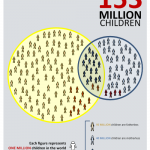
153 MILLION children have lost at least one parent. 

That’s roughly half the population of the United States.

That’s 8.3% of ALL the children in the world.


  • 95 Million children who have no father to play catch with.
    (More than the population of Germany!)
  • 40 Million children with no mother to kiss them goodnight.
    (More than there are people in California!)
  • 18 Million children with no parents at all to love them or protect them.
    (Almost as many people as in the State of New York)


What are we going to do about it? Leave a comment…

This is important. Subscribe via email or RSS so you don’t miss a post, and use the buttons right here to tell your friends and followers about this. Awareness –> Action –> Impact

« Older entries